


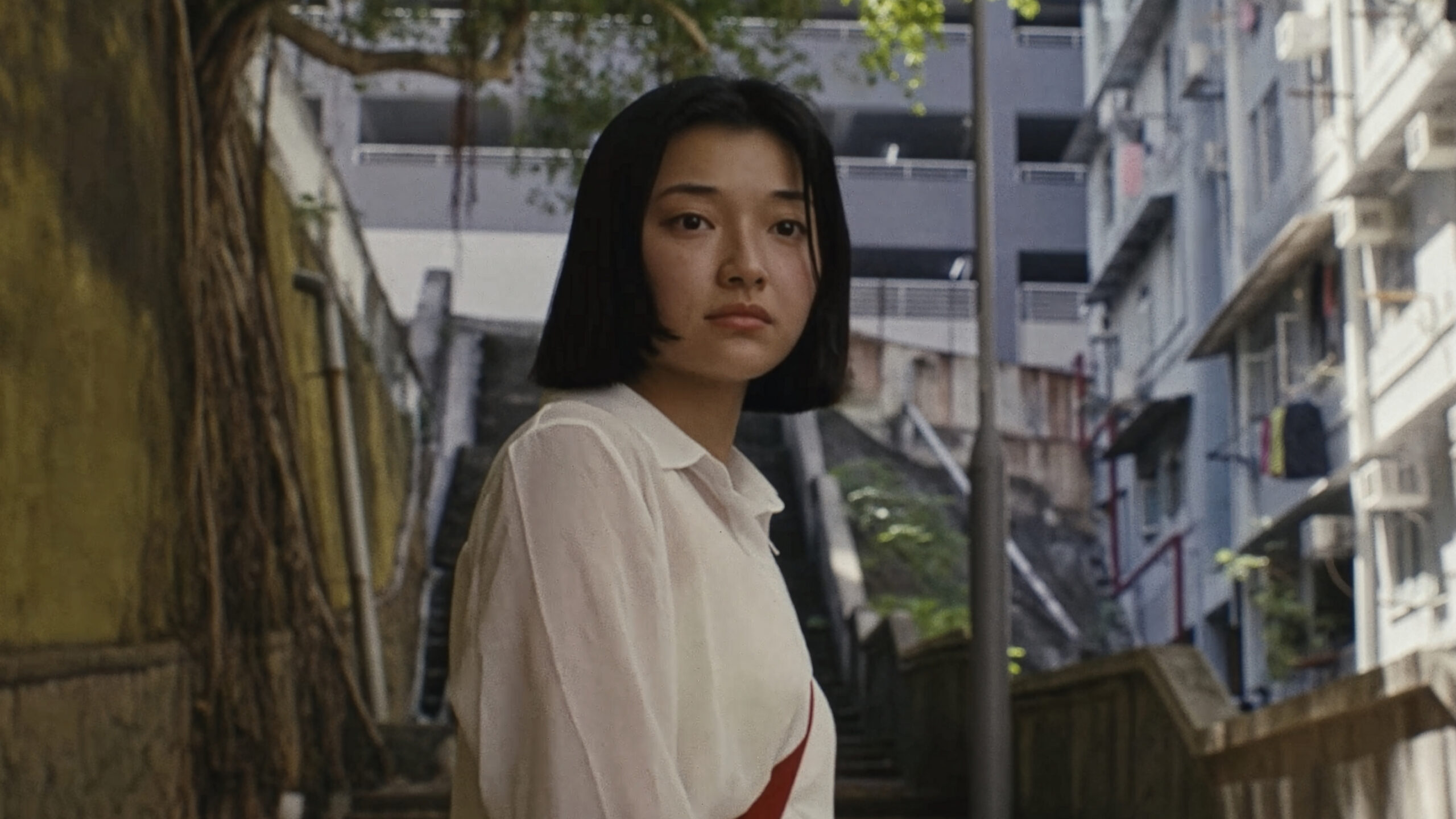
A lyrical portrait of a city and a tender traipse through time and memory, Kogonada’s newest, “zi,” is a contemplative return to form for the filmmaker. Following the release of his first big-budget studio project, “A Big Bold Beautiful Journey,” this film presents something entirely different: a promising speculation that the filmmaker’s home base is in authentic indie filmmaking.
With trust and instinct at the fore, “zi” came together moment by moment in Hong Kong by way of guerrilla filmmaking techniques. This utter presence is felt in the film’s mindfulness, as we both drift through and give chase to the construct of time itself. Anchored by a profound sense of place, “zi” operates in similar contexts as the filmmaker’s stunning debut, “Columbus.” But where the latter sentimentalizes the growing pains of leaving home, this present edition unearths the complexities of diaspora and loneliness with one’s current locale.
Zi (Michelle Mao), the titular protagonist, might have a brain tumor. It also might be some other amorphous affliction, one that causes her to perceive time at a delayed pace. This disconnect from routine leaves her wandering the congested metropolis of Hong Kong alone, burdened by visions of her future and the uncertainties woven into it.
Discovered weeping on a staircase by American expat El (Haley Lu Richardson), the two move through the dubious night together, with Zi under her wing. They’re eventually joined by Min (Jin Ha), an initially questionable character who then becomes integral to stabilizing the trio’s pursuit for comfort and answers.
Above the bustling lobby of the Sheraton Hotel, Park City’s home base for all things Sundance, director Kogonada and cinematographer Benjamin Loeb sat down with me to discuss the inner workings of the film, its cultural and historical weavings, and their foundational trust as collaborators.

Courtesy of Sundance Institute | photo by Ian West / PA Images.
You guys were between five cities when choosing a locale for the film. What was it about Hong Kong that was decisive for you? It’s hard to imagine this film being set anywhere else.
Kogonada: The five cities were more of an exercise, but this film always felt like Hong Kong. It’s almost a mythical place because of its history, cinematic and otherwise. Hong Kong is so stuck in the past because it’s been colonized repeatedly. Thematically, it felt really in line with the story, and its textures were so compelling.
BL: I’m always inspired to go to new places and to experience things for the first time. Especially with a project like this, where you have to react in a sort of documentary way to what is in front of you. We knew it would offer textures, colors, and geography that were also visually interesting, so it made it incredibly easy to photograph.
K: It has its own story to tell, and we hope that “zi” is also a story of Hong Kong. When they say in the film, “for you, it’s always the past,” I think of Hong Kong. The country is both a victim of their past and defined by it. As a place where people tell stories in the modern world, Hong Kong is emblematic of what it means to be a modern being.
The country’s colonial history is relatively recent compared to other nations, and the film’s portrayal of the diaspora is prominent. Min has a complex relationship with Hong Kong; Zi refuses to answer whether she was born and raised there, and yet El has the privilege of being an expat and connecting to the country in an entirely different way.
K: People have complicated histories, and there is such a difference between the diaspora and expatriates. We were trying to explore people being out of time and out of sync with the world’s dominant rhythm. It’s about trying to chase after what it means to be part of a world that has its own tempo.
I like your use of the word rhythm, because tracking shots are so integral to the visual language of the film, and they’re employed in so many different rhythms: steady and composed at times, and erratic at others. What was it like capturing and choosing moments of stillness vs. chaos?
BL: Rhythm and pace have been such a big part of our discussions, and when we talked early on about the film, verité language was very much at the forefront. But without the stillness and composure that the tableaus and cityscapes provide, it becomes flat in a way. The contrast and conversation between those two languages make it powerful.
Something that popped in my head during the film was the sort of centerpiece quote from Slaughterhouse-Five, “Billy Pilgrim has come unstuck in time.” Given that it’s an anti-war novel and this has a peripheral story about colonial history, I was wondering if you had any sources of inspiration for politics and the portrayal of time in art.
K: I love that. “Hiroshima Mon Amour” is a political film, but so much of that language is the slippage of time and the reconstruction of history. That is very much the language here and a prompt of what it reveals about our presence. Chris Marker’s “La jetée” as well. Sundance used the term “transitory misfits” to describe our film, and I love that expression. I want it on my tombstone. There’s a whole cinema of transitory misfits, and I think you know if you are one.
Hong Kong’s architecture lends itself to a sense of wandering and lostness. In that cemetery scene, for example, everything is so vertical, and the graves read as their own kind of metropolis within the city. In “Columbus,” Casey is in the company of the architect, where it feels like it is dwindling.
BL: I feel like Hong Kong has that quality, but for me, I was always focused on shooting Zi’s face. Architecture and the surroundings were guiding us in choosing the texture we wanted to ground the film in, but I was always fixated on how to capture faces and find a natural rhythm among the characters.
K: The very first scene we shot was the fireworks scene, and there was so much on Michelle’s face. After that first day, Benjamin and I looked at each other and thought, “We have a film.” But speaking to the cemetery sequence, it really does capture the height and density of Hong Kong. What I love about that is that it’s like a mountain of the dead, and we cut to a stacked building. El says, “We’re all dying.” We’re all in the state of it, and it’s telling this modern story of a woman trying to find her place in this world: the architecture that surrounds her is a testament to the weight of that.
I’m curious about the portraiture you mention. Those tracking shots that are so integral to the film are often from behind, and it feels very selective about when we get these head-on moments of ID. It reminds me of when Zi says she feels her parents’ faces fading.
BL: Kogonada and I have always discussed the emotional qualities of performance. Very often in filmmaking, there’s this necessity to see the eyes to feel the emotion. We talked about concealing the face, and there’s a give and take there, but I’ve always loved the shape of the body, and that the back of someone’s head contains this intrigue and mystery.
K: When it comes to forgetting what her parents look like, this motif arose of Zi as a figure roaming through the city without a face. But the moments where she does stop and turn to the camera are so powerful because of the magnetism she carries. It pierces you.

That idea of obscurity and anonymity, as well as the density of Hong Kong population-wise and architecturally, really lends itself to Min’s voyeurism, as well as the kismet of Zi and El finding each other. Them, as a dichotomy between active and invisible guides for Zi, can be both comforting and really unnerving. I’m curious about crafting those relationships.
K: Being part of a city, you feel both of those dynamics at play. You’re brushing against humanity. It’s not an anonymity of recluse, and there’s tension there. The mystery of Min, despite the story we have that plays out, is a consequence of that inherent state of a city dweller.
Cinema itself, to me, is a commitment to memory. Even in the obscurity of time and identity in this film, there’s a landscape put together here that feels like a preservation of Zi, even though she herself doesn’t feel attached to it. The same goes for Sakamoto’s music, which you’ve further immortalized in this film (and to whom the film is dedicated). What is your relationship with cinema as memory? And was his music always integral to this story?
K: I’ve really felt Sakamoto’s absence from this world since he passed. He has all this music he created after he found out he had a terminal illness, and most of that music is in our film. That exploration of impending absence and reflection on memory was really inspiring here. In my own life, cinema functions the same way. It’s a deep part of my memory, even in the way that cities I’ve never been to feel like memories because the streets of them live within me from the films I’ve seen.
In capturing the feeling of memory in the film, Benjamin uses lens flares in the portraiture and other elements that make those sequences visually disparate. How did you go about constructing those moments?
BL: We always curate our ingredients to find meaning within the medium in some way. The memories were mostly shot on a Bolex. There was no monitor; we weren’t seeing anything as we were shooting. We were just trusting the tool.
K: On the Bolex, which was shooting film, Benjamin let those light spills happen. They’re a part of what we captured; they weren’t added to stylize. They just kind of became part of the language of our film.
You two worked together on “After Yang” and “A Big Bold Beautiful Journey.” There’s this theme of relinquishing yourself to the trust you have in one another, as well as in the actors. With this film being put together in this impromptu way, what did you learn about trust as a team, as well as individuals, in your own instincts?
K: We have such a unique three-film collaboration. We started with an independent studio, then moved to a gigantic studio film, and in many ways, the structure of our desire to make films in a different way remained the same. Doing this third film, obviously, it was so absolutely independent. These three films I’ve made with Ben have all been in different contexts, but “zi” is fundamentally closer to what we both respond to and what feels invigorating to us. It requires trust because we don’t have safety nets. But also, safety nets are often attuned towards risk aversion, which then creates layers of logistics, and suddenly you’re not able to make real, in-the-moment choices. It shouldn’t be radical in film to make choices on the day, but it is. That action is what led us to Hong Kong.
BL: We could’ve never made this movie two films ago. The conversations and trust built through those other projects made this possible. We only had three days to scout the city, but we had three years of conversations deconstructing the construction of filmmaking and asking those questions.
K: The people around us also had the same characteristic. It couldn’t have been possible without the seven people we had, and three actors who really trusted the process. It’s really a testament to trust and the pursuit of the same thing creatively.
The scene where Min is singing is the only piece in which we are placed directly in Zi’s perspective: the audio carries over into a nebulous echo when he finishes singing. And during the song, we cut away to these empty hollows of alleyways and corners that make us feel like ghosts in space.
K: We had a collaborator, Sheldon Chau, who did those empty Hong Kong shots. We told him to focus on those feelings of emptiness and melancholy, and then sort of sent him on his way to capture them. For that moment, where it coincides with the feeling Zi is having, it becomes a perfect marriage of that feeling with that John Denver song.
BL: Most of this film, in a weird synchronous way, presented itself to us. We didn’t construct it, but that scene specifically was in an in-between day after writing and editing. We walked out of the hotel and across the street and happened upon this little corner. Space dictates the way you see the potential blocking of something—the bench and the dangling lightbulb were just there, and then there was no question of how to shoot it, it was just there in the moment.
El makes a statement in the film about her capture of the city’s sounds: she doesn’t do it for the money, but to keep going. What’s your relationship with that as a philosophy of creative pursuit?
K: I think that’s a really insightful quote to pull out in this moment because we didn’t do this for money. All of us could’ve taken fees or other jobs, but we didn’t. Often, independent films like this are seen as stepping stones into the system. But we had all worked in the system, and this wasn’t a calling card for that; it was a way of being. For me, I needed to do this to keep going if I’m going to continue doing films. There come times when you find yourself in situations so far removed from the cinema that spoke to you. It was a reset for me and a genuine venture to pursue meaning.
BL: I’ve been thinking about it in a different way. As journalism becomes colored by corporate and political agendas, there are also films that are informed by marketing agendas and box office numbers. But when you look at real independent cinema from filmmakers across the world who have something to share, these little glimpses into the past or future become so important as stamps of time. This film was just about finding something that feels real and true in the moment and putting it out as a letter of some sort.
That really speaks to the power of choice and discernment in filmmaking. There’s another quote from that same monologue, when El laments that her passion didn’t choose her back. Do you feel chosen by this craft? Or is choice even a factor for you—is radical pursuit the point?
BL: There was never really a question. If you really think about writing, music, movement, dance, etc., filmmaking really combines all these things. And I was never good at communicating my feelings. I felt like I could release them through images. Film isn’t a singular medium, so finding collaborators that I could meet in the middle was instrumental.
K: In so many conversations I have with creative people, they are desperate to do the thing they feel called to do. But in our world, it’s a select group. Everyone who has the talent doesn’t get to do it. I feel the pain of what it is to want something so desperately while knowing that our capitalist system doesn’t nurture creativity. I think artistic expression is a deep part of being human, but figuring out how to live off that is a whole other thing. To me, there’s no answer to the question. What El is saying is true for her. I don’t know if a purpose chooses you or vice versa, but it’s an expression of a feeling that many people have and have to reckon with.